
Custom Software
DIP Job Tracker for Odoo
Manage the entire operational and financial lifecycle of a job from a single Odoo dashboard — planning, cost tracking, invoicing, and profitability, all in one place.
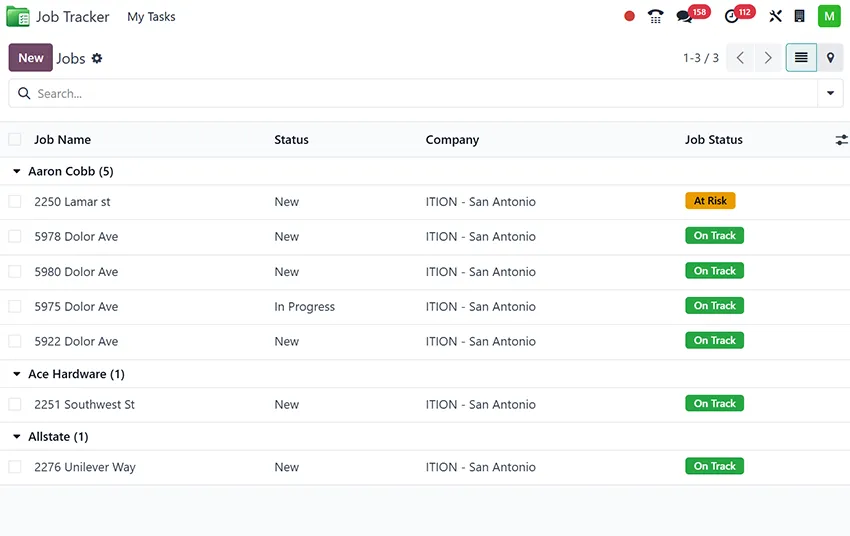
SEE IT IN ACTION
DIP Job Tracker Showcase
The challenges job-based businesses face
Construction firms, contractors, field service companies, and project-focused distributors all run on a job-based model — and every job has both an operational side and a financial one that need to stay in sync. Standard ERP systems, Odoo included, don't ship with a single workspace for planning, executing, monitoring, and closing out a job while keeping budget and profitability in view the whole time.
- Fragmented information — job details, timelines, and budgets are scattered across different systems or spreadsheets.
- Poor cost tracking — operational teams track progress while finance teams separately track expenses, leading to mismatched data.
- Delayed profitability analysis — by the time all the numbers are reconciled, it's too late to make course corrections.
- Inefficient communication — project updates and financial changes aren't communicated quickly between departments.
How the Job Tracker module solves the problem
We built the Job Tracker module to unify operations and finance into a single, Odoo-integrated workspace, where tasks, resources, expenses, and revenue all tie directly back to the job record — giving everyone real-time insight and one source of truth.
Key features
Seven capabilities work together to give a job its own operational and financial command center:
- Comprehensive job dashboard — project timeline, assigned team members, progress percentage, budget vs. actual cost, revenue billed, and profitability indicators, all in one view.
- Operational planning and scheduling — tasks and subtasks that break the job into actionable steps with deadlines, resource allocation across employees, equipment, or subcontractors, and Gantt-style timeline visualization.
- Real-time financial tracking — labor hours logged automatically contribute to job costs, purchase orders for materials tie directly to the job, and expenses are recorded in real time.
- Revenue management — supports fixed-price contracts, time-and-materials billing, and milestone-based invoicing.
- Budget vs. actual analysis — built-in reporting compares planned budgets to actual spend and revenue in real time.
- Profitability tracking — shows gross margin to date, estimated final profitability, and variance from initial projections.
- Integrated communication and documentation — keeps all job-related documents, plans, contracts, and change orders in one place.
How it works in practice
Every job follows the same five-step lifecycle:
- Job creation — new jobs are established with scope, timeline, budget, and resources.
- Execution — teams log work and expenses directly against the job.
- Ongoing monitoring — managers track operational and financial metrics in real time.
- Invoicing — revenue is billed according to contract terms.
- Close-out and analysis — final profitability is calculated and lessons are recorded.
Business benefits
Bringing operations and finance together in one module shows up in five concrete ways:
- One source of truth — all job data, tasks, costs, and revenue, lives in one place.
- Proactive decision-making — real-time financial tracking allows mid-project adjustments.
- Higher profit margins — cost overruns are caught early instead of after the fact.
- Faster billing — invoicing is accurate and timely, improving cash flow.
- Improved collaboration — operations and finance work from the same data set.
Real-world use cases
The module fits any business where a job — not the calendar — is the unit that needs to stay profitable:
- Construction company — tracks labor, materials, and subcontractor fees against each project.
- Event management firm — monitors operational planning and vendor expenses for every event.
- Custom manufacturer — manages customer orders as jobs with production tracking built in.
- Field service provider — oversees multiple client jobs simultaneously from one workspace.
Why choose our Job Tracker module
The module is fully integrated with Odoo's sales, purchasing, inventory, and accounting, customizable to match your industry's workflows, and scalable for businesses managing a handful of jobs or hundreds simultaneously.
The bottom line
Managing jobs effectively means managing both the work and the money. The Job Tracker module gives you a complete operational and financial command center for every job — leading to better decisions and stronger margins.
A FEW HELPFUL ANSWERS
Frequently asked
questions.
Need to work through the specifics?
Let's talk about your project.
What kinds of businesses is the Job Tracker module for?
Any job-based business — construction, contracting, field services, event management, custom manufacturing, or project-focused distribution — where each job needs its own budget, timeline, and profitability picture.
Does it integrate with Odoo's existing modules?
Yes. It is fully integrated with Odoo's sales, purchasing, inventory, and accounting, so labor, purchase orders, expenses, and invoices post directly to job costs without duplicate data entry.
Can it handle many jobs running at the same time?
Yes. The module is built to scale from a single job up to hundreds running simultaneously, each with its own dashboard, budget, and profitability tracking.
YOUR NEXT STEP
Let's talk about your next project
Tell us what you want to improve. We will help you define the next step.